
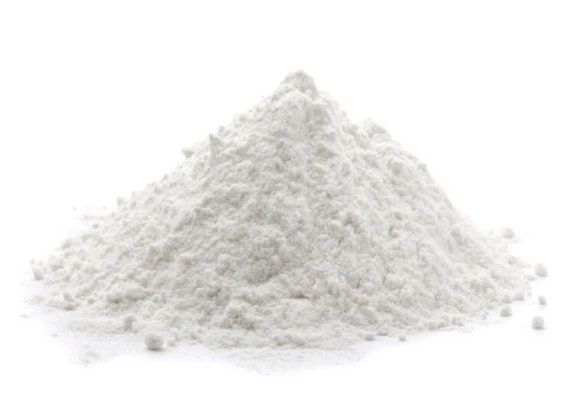
Pouliquen, O., 2025 Powders and cohesive granular media: a rheological perspective. Rheologica Acta, 64(4), 195-207
DOI: https://doi.org/10.1007/s00397-025-01490-2
This paper provides a rapid overview of the mechanics of cohesive granular materials and powders, with a particular focus on the development of constitutive equations for the steady flowing regime. We begin by reviewing the various sources of adhesion between particles, before exploring the onset of flow in cohesive materials…
While yield conditions are central to many characterization methods, they provide limited insight into flow behavior. We then discuss recent studies on the flow of cohesive granular materials, emphasizing the development of constitutive equations. A direct comparison of results from DEM simulations across different studies highlights the importance of the interaction model details but reveals key insights into the relevance of different dimensionless numbers, paving the way for a more comprehensive rheological description of powders.
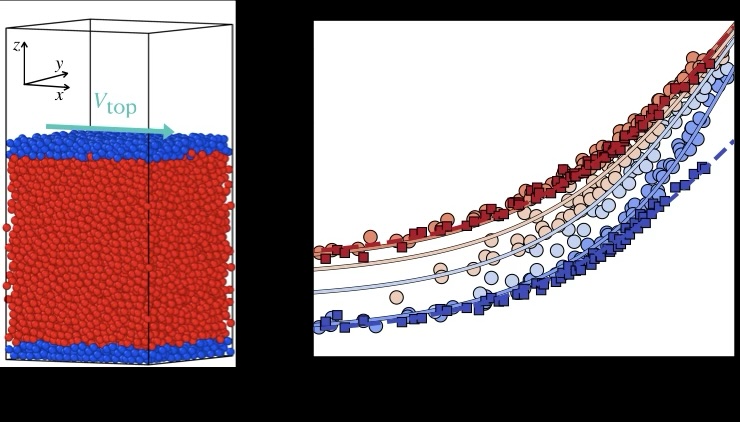
Dumont, D., Rocha ,F. M., Nicolas, M. & Pouliquen, O. 2025 Discontinuous shear thickening in dry granular materials induced by non-Coulombian friction, Phys. Rev. Fluids 10, 064302
Over the last decade, the physics of discontinuous shear thickening (DST) in dense suspensions has undergone a paradigm shift. Growing evidence indicates that it stems from a frictional transition at the particle scale induced by repulsive forces between the suspended grains…
However, in dry granular materials, interparticle friction can also exhibit a transition when the grains are coated, typically with polymers or lubricants widely used in industry. In this work, we use discrete-element method simulations to demonstrate that DST occurs in dry granular materials when considering non-Coulombian behavior, where the interparticle friction varies with the contact normal force to mimic the influence of a coating. By performing pressure- and volume-imposed measurements, we reveal all regimes of dry shear thickening and present a mean-field model that predicts the observed scenarios by relating the bulk rheology to the microscopic friction law.
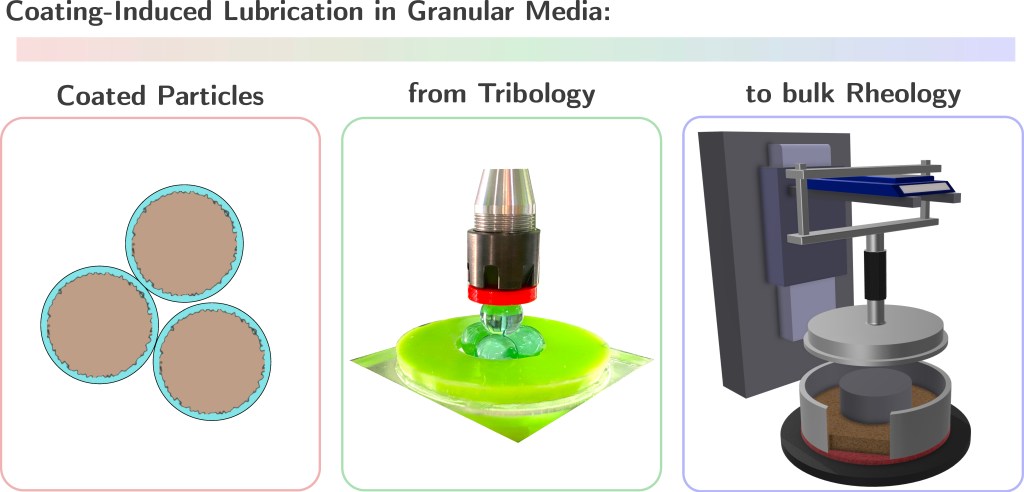
Rocha, F. M., Dumont, D., Tapia, F., Gans, A., Bertin, V., Nicolas, M., & Pouliquen, O., 2026 Coating-induced lubrication in granular media: from particle-scale tribology to bulk rheology. Soft Matter.
Coated granular materials are involved in numerous industrial processes, including powder handling in pharmaceuticals, additive manufacturing, cement production, and food processing, where surface treatments control flowability, prevent agglomeration, and improve product consistency. Despite their widespread use, the influence of coatings on the collective behavior of granular materials remains poorly understood…
While dry granular flows are well described by the μ(I) rheology for frictional, noncohesive particles, many real-world systems involve additional interparticle interactions that fall outside this framework. Here, we investigate how polymer coatings on silica grains modify dry granular rheology by introducing non-Coulombic frictional behavior at the particle scale. Pressure-imposed rheological experiments reveal that coatings activate a low-friction regime in which the bulk friction coefficient and packing fraction approach values typical of frictionless grains. The transition from this lubricated state to a conventional frictional regime depends on both normal stress and shear rate, indicating stress- and velocity-dependent contact mechanics. Tribological measurements show that interparticle friction decreases with coating thickness and sliding velocity, but increases with normal load. Building on these findings, we develop a mean-field rheological model that extends the classical μ(I) framework to include coating-dependent, non-Coulombic friction. Discrete Element Method simulations incorporating the measured friction law capture the key qualitative features observed experimentally. These results demonstrate that controlled surface coatings provide a powerful route to engineer granular rheology and enhance flowability across various industrial applications.
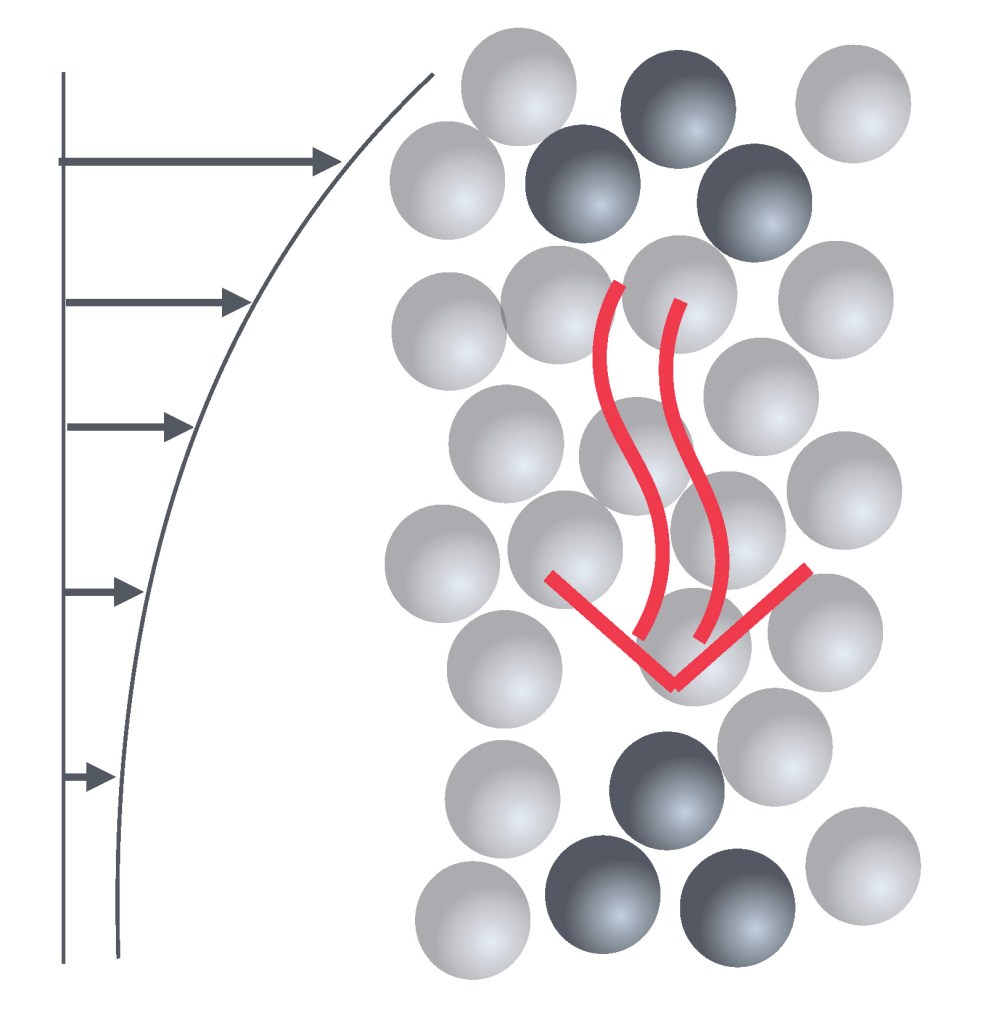
Pouliquen, O., 2026 Non-local rheology in granular media: a perspective on the 2015 EPJE Paper by Bouzid et al.. Eur. Phys. J. E 49, 32.
The study ”Non-local rheology in dense granular flows: Revisiting the concept of fluidity,” published in 2015 in The European Physical Journal E (vol. 38) by Mehdi Bouzid and collaborators, stands as an important contribution to the rheology of granular materials…
In their work, the authors critically discuss the differences between proposed non-local models and provide clear pathways to discriminate between them. This perspective paper revisits the state of the art at the time of the Bouzid et al’s publication, highlighting its role in inspiring subsequent research. We then explore recent advancements since 2015, which, while significant, have not yet fully resolve the questions originally raised by Bouzid et al.
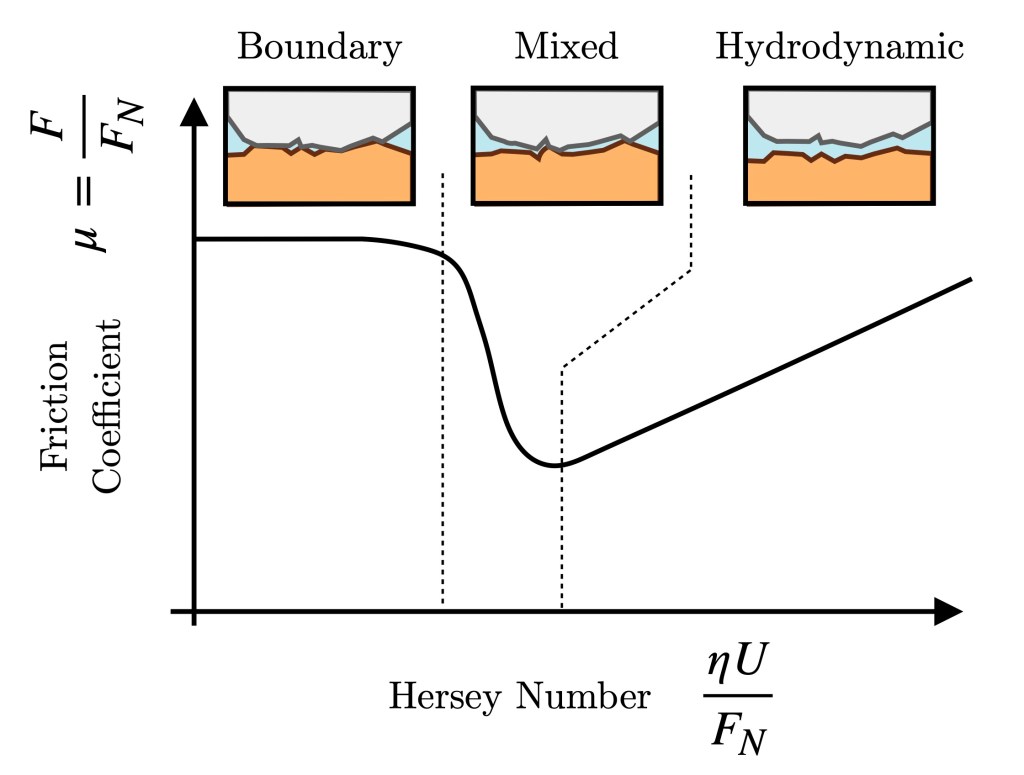
Bertin, V., & Pouliquen, O., 2026 Transition from contact to hydrodynamic lubrication over rough surfaces, preprint.
We present a theoretical analysis of frictional transitions along the Stribeck curve for rough elastic contacts lubricated by a Newtonian fluid. Building on the mean-field framework of Persson and Scaraggi (J. Phys.: Condens. Matter 21 (2009) 185002), we formulate a minimal elastohydrodynamic model that couples contact mechanics and lubrication through a homogenized pressure decomposition…
Dimensional analysis reveals three independent dimensionless parameters governing the frictional response, which correspond to a dimensionless speed, normal load, and surface roughness. Using asymptotic expansions, we first characterize the boundary and hydrodynamic lubrication regimes, which arise naturally as the quasistatic and smooth-surface limits of the model. In both limits, the contact morphology converges toward Hertzian contact in the regime of large elastic deformation, with boundary layers regularizing the separation profile at the edge of the contact zone. We then analyze the mixed lubrication regime and derive asymptotic expressions for the friction coefficient in the low- and high-speed limits. At high speeds, friction decomposes into a viscous contribution and a residual contact term, leading to a roughness- and load-dependent criterion for the transition to hydrodynamic lubrication that departs from constant-Λ ratio theories. At low speeds, friction reduction results from the progressive redistribution of the applied load between asperity contact and hydrodynamic pressure, yielding a characteristic transition speed from boundary to mixed lubrication. These results are summarized in a phase diagram that generalizes the classical Stribeck curve to a multidimensional parameter space.

